
Tingkatan Logika Syaraf (NeuroLogical Level)
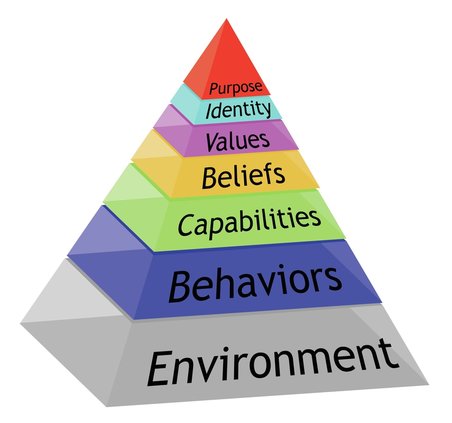
Anthropologist Gregory Bateson identified four basic levels of learning and change - each level more abstract than the level below it; and the higher the level, the more impact on the individual (Dilts 1994). These levels roughly correspond to:
- a. Who I Am - Identity (Mission and Purpose) Who?
- b. My Belief System - Values and Meanings Why?
- c. My Capabilities - Strategies and States How?
- d. What I Do or Have Done - Specific Behaviors What?
- e. My Environment - External Constraints Where? When?
Mari kita analogikan dengan "Beri manusia ikan dan dia bisa hidup sehari; ajari dia cara memancing dan dia bisa hidup seumur hidup" kita bisa melihat bahwa "makan ikan" ada di tingkat perilaku dan "belajar cara ikan "berada pada tingkat kemampuan, mirip dengan" belajar cara belajar "yang telah menjadi populer di bidang kami dalam beberapa tahun terakhir. Ketika kita melangkah lebih jauh, Anda dapat membayangkan bagaimana rasanya mengilhami manusia ikan ini dengan keyakinan bahwa ia tidak hanya dapat belajar menangkap ikan, tetapi juga untuk berburu, bertani, peternakan, atau membangun bisnis jika ia mau. Mendukung kepercayaan semacam itu bisa menjadi identitas dirinya sebagai pembelajar, sebagai seseorang yang memiliki potensi dan orang yang berharga.

A language learner might express these levels in the following way:
I am (not) an English speaker.
Identity It's good (bad) to speak English.
Beliefs I (don't) know how to speak English.
Capability I (don't) do what my teacher says.
Behavior School is part of my Environment.
Starting from the bottom and going up, we could say that we send students to school and put them in a certain Environment. In this environment we hope to cultivate certain Behaviors. Sometimes when students behave a certain way long enough they develop the strategies and states that give them the Capability to reproduce language regularly. This is the bet of organized education, that it will create skills faster than other less organized activities outside of school. Sometimes this happens and sometimes it doesn't. My guess is that when it happens it is because either students already come with supporting beliefs and identities ("I can learn" and "I am a learner") or teachers intuitively provide an environment where they can cultivate supportive identities and beliefs that make the learning of skills and behavior more possible (Some fields are naturally fertile while others need fertilizing. And it's also nice to plant in season and with proper irrigation. Plant while the planting is good!).
Some of the performative task criteria that might be applicable and need testing and verification by teachers may correspond to the following levels:
- Environment: It's possible to do it in every day life.
- Behavior : It's actually physically easy and possible (e.g. asking the time of foreigners).
- Capability: Doing the task shows that they can do it (have the ability to) and at the same time improves their ability to do it.
- Beliefs: The task challenges limiting beliefs and presents options.
- Identity: A person's identity-map may be broadened, or opened up, by the possibility of new beliefs.
https://g.co/kgs/DghqBk
rujukan http://www.nlpu.com/Articles/LevelsSummary.htm
